
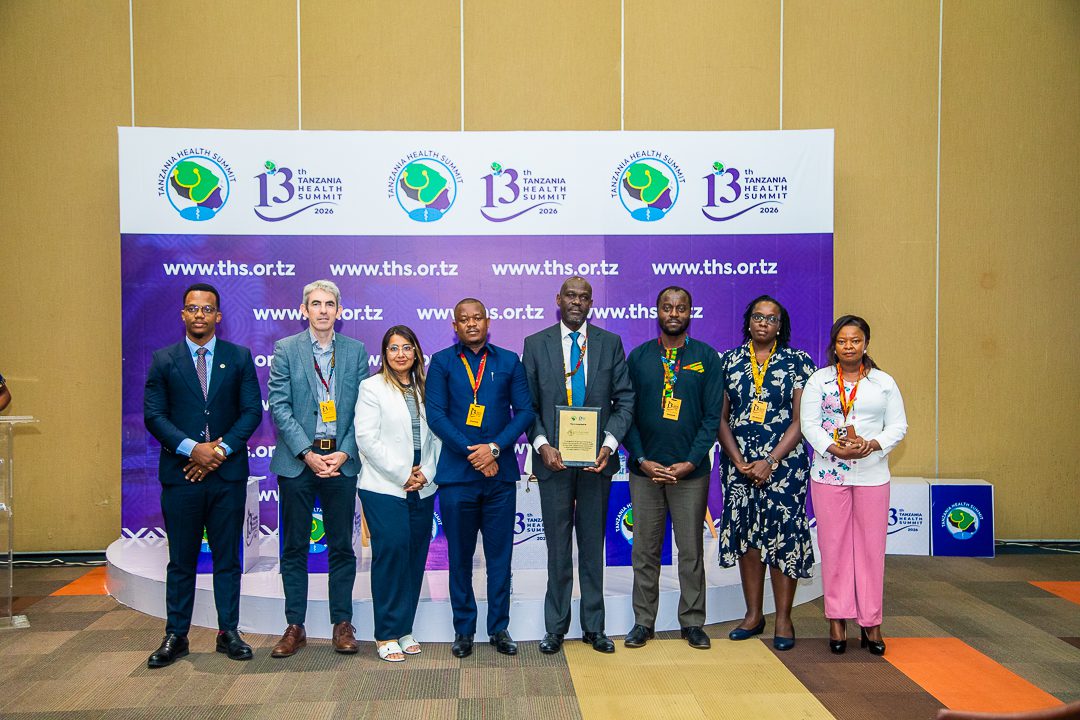
At the Tanzania Health Summit 2026, the Africa Public Health Foundation (APHF) joined continental partners to highlight the importance of skills development, strategic partnerships and coordinated investment in building Africa’s pharmaceutical manufacturing capacity.
Africa’s ambition to strengthen local pharmaceutical and vaccine manufacturing will depend not only on investments in infrastructure and technology, but also on developing a skilled workforce capable of supporting a sustainable manufacturing ecosystem. This was a key message from a panel discussion at the Tanzania Health Summit 2026, which brought together leaders from public health, academia, industry, vaccine development and continental institutions to explore how Africa can strengthen its pharmaceutical and vaccine manufacturing capacity.
Dr Ambrose Talisuna, Chief Executive Officer of the Africa Public Health Foundation (APHF), opened the discussion, which was moderated by Jon Harle, Executive Director of the International Network for Advancing Science and Policy (INASP)which has been in discussions with APHF to develop this initiative. He emphasized that Africa’s pharmaceutical and vaccine manufacturing ambitions must be matched by investment in skilled people and practical training.He highlighted the gap between academic training and the technical competencies required by the manufacturing industry, stressing the need for stronger collaboration among universities, manufacturers, regulators, governments and development partners. He also underscored the importance of Good Manufacturing Practices, quality assurance and regulatory capacity in ensuring that locally produced medicines and vaccines meet international standards.
Dr Talisuna called for coordinated continental action to align curricula with industry needs, expand practical training opportunities and strengthen partnerships that can help Africa transition from dependence on imported health products towards greater self-reliance and health sovereignty.The panel highlighted the importance of aligning education and training with industry needs, strengthening regulatory capacity and fostering collaboration among governments, universities, manufacturers and development partners. As African countries work towards greater health sovereignty, participants emphasised that shortages of specialised skills remain a significant barrier to expanding local production. Critical areas include Good Manufacturing Practice (GMP), quality assurance, quality control, regulatory affairs, clinical research, bioprocessing and pharmaceutical manufacturing.

Bridging the Gap Between Training and Industry Needs
The discussion highlighted the disconnect between university training and the practical competencies required in manufacturing environments. Graduates often have limited exposure to industrial production processes, creating a need for additional workplace training.
The panel highlighted the importance of aligning education and training with industry needs, strengthening regulatory capacity and fostering collaboration among governments, universities, manufacturers and development partners.As African countries work towards greater health sovereignty, participants emphasised that shortages of specialised skills remain a significant barrier to expanding local production. Critical areas include Good Manufacturing Practice (GMP), quality assurance, quality control, regulatory affairs, clinical research, bioprocessing and pharmaceutical manufacturing.
Prof. Eulambius Mlugu of Muhimbili University of Health and Allied Sciences (MUHAS) contributed the academic perspective, while Ms Shemina, Chief Executive Officer of Afya Cure Pharmaceuticals and Secretary of the Tanzania Pharmaceutical Manufacturers Association, brought the industry’s perspective to the discussion.


Strengthening Vaccine Manufacturing and Technology Transfer
Ondari Mogeni, Lead Government Relations at the International Vaccine Institute (IVI), contributed perspectives on vaccine manufacturing, technology transfer and training.The discussion underscored the importance of developing the technical expertise required to support vaccine production, alongside investments in manufacturing infrastructure. Building local capacity will require collaboration with technical partners, specialised training and opportunities for knowledge and technology transfer.
IVI’s engagement in South Africa offers a practical illustration of this approach, combining technology transfer, manufacturing capacity building and workforce training to advance regional vaccine independence.In 2022, IVI began a technology transfer partnership with South Africa’s Biovac to expand local production of its oral cholera vaccine (OCV-S). The partnership has since entered an extension phase focused on scale-up, chemistry, manufacturing and controls (CMC), stability testing and preparation for an Investigational New Drug (IND) application.


IVI also provides on-site training and technical consultation to Afrigen, the WHO-designated mRNA technology transfer hub in South Africa, supporting biopharmaceutical and mRNA vaccine development.On workforce development, IVI has collaborated with South African Health Products Regulatory Authority (SAHPRA), South African Medical Research Council (SAMRC) and United States Pharmacopeia / Promoting the Quality of Medicines Plus (USP/PQM+) on workshops in Cape Town that train local scientists and regulators in GxP quality management, clinical development (including Vi-DT typhoid vaccines) and aseptic processing.
At the continental level, South Africa is a co-convener, alongside the African Union, IVI, Africa CDC and other partners, of the ACHIEVE Africa initiative formally launched on February 15, 2026, during the 39th Ordinary Session of the Assembly of the African Union in Addis Ababa, Ethiopia. The US$100 million, five-year research and development ecosystem aims for local production of 60% of Africa’s vaccines by 2040.These efforts are essential to strengthening Africa’s ability to develop and sustain its pharmaceutical and vaccine manufacturing ecosystem.
Creating an Enabling Environment for Local Manufacturing
Beyond workforce development, manufacturers face challenges including high production costs, competition from lower-cost imports, limited investment incentives, regulatory hurdles and difficulties retaining specialised personnel.Addressing these barriers will require coordinated action by governments, regulators, industry and development partners. Participants underscored the importance of predictable markets, supportive local procurement policies, technology transfer and streamlined regulatory processes to strengthen the competitiveness and sustainability of African manufacturers.
The continental perspective was represented by David Walisumba and Elirehema Heriel Mfinanga of the African Union Development Agency–NEPAD (AUDA-NEPAD), who joined the discussion online reiterating that the skills required are critical to this ambition. AUDA-NEPAD is about to launch the SCALE programme (Securing Continental Access to Life-saving Essential health products), a strategic initiative to strengthen Africa’s health sector by linking industrial growth directly with public health. Its primary goal is to establish reliable, localised access to essential health products across the continent. SCALE complements the African Medicines Agency (AMA) and is anchored in the Pharmaceutical Manufacturing Plan for Africa (PMPA). It operates through three core pillars: Health Technology Assessment, manufacturing competitiveness and supply chain security.


 An interconnecting pillar focuses on enhancing health workforce skills and building resilient institutional capacity across Africa. This ensures the continent can support and sustain its own health product value chain, from local pharmaceutical manufacturing to regulation and delivery.Continental collaboration was identified as a priority. Through regional cooperation, harmonised regulatory standards and opportunities under the African Continental Free Trade Area (AfCFTA), African countries can work towards larger markets, more efficient supply chains and a stronger regional manufacturing base.
A Skilled Workforce for Africa’s Health Security
The discussion reinforced the need to treat pharmaceutical and vaccine manufacturing as a continental priority, supported by investment in people, practical training and stronger partnerships.


For Africa to translate its manufacturing ambitions into sustainable production capacity, universities must work more closely with industry, governments must create enabling policy environments, and manufacturers must invest in developing and retaining skilled personnel.The contributions from public health, academia, industry, vaccine development and continental institutions highlighted the importance of a coordinated approach to building the capabilities required for sustainable local production.
Ultimately, Africa’s pharmaceutical manufacturing future will be shaped not only by the facilities it builds, but also by the skills it develops and the partnerships it sustains.
